
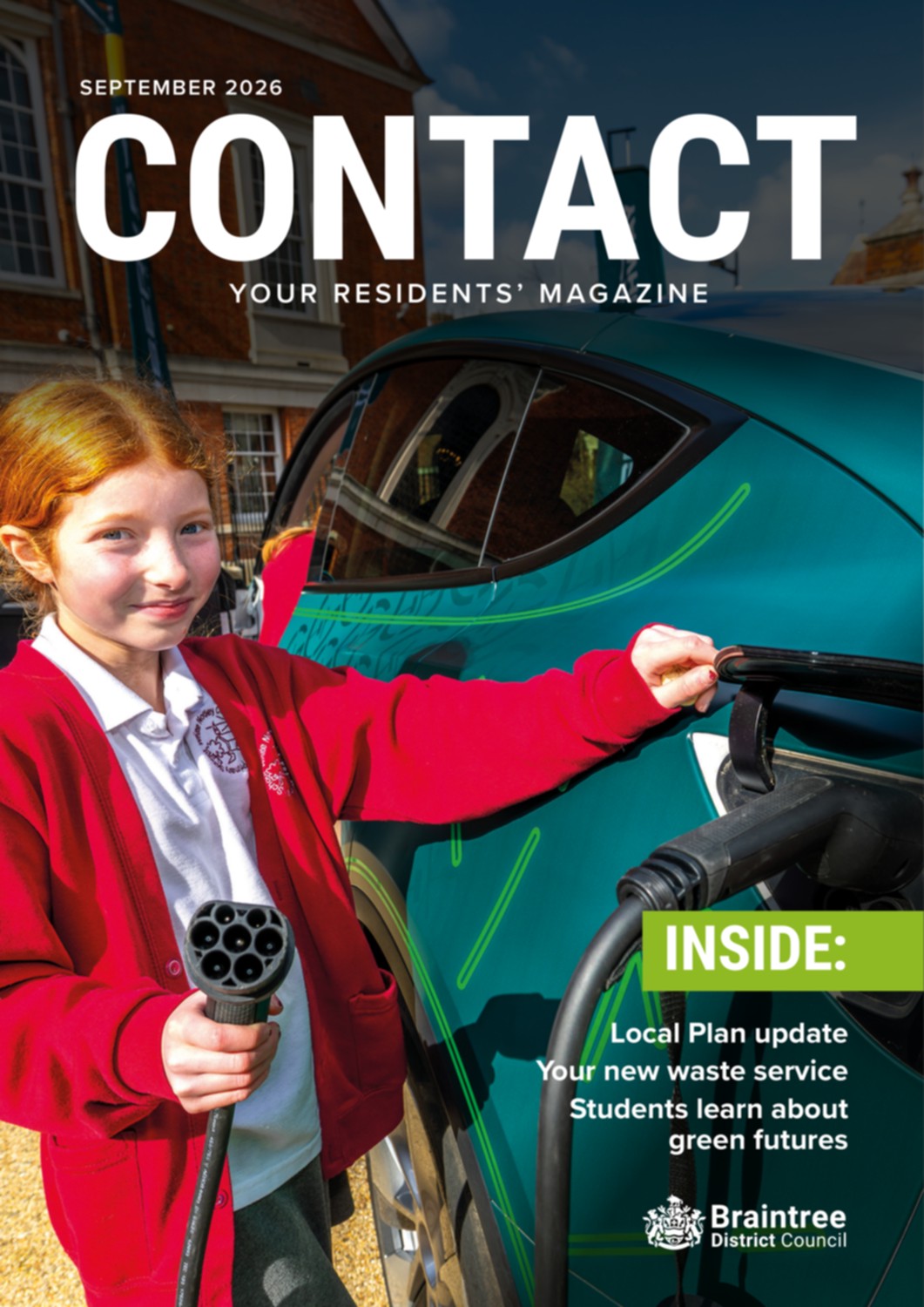
Read the latest news and information from Contact magazine - September 2026.
Contact Magazine - September 2026
Articles in this edition:
- Letter from Councillor Tom Cunningham
- Investing in what matters most
- Local Plan Update: Helping shape the future of our district
- Let’s clear the air
- Thank you for supporting your new waste service
- Help to stay warm for less this winter
- Mental health support in the Braintree District
- Community Safety
- Eco-themed activity day
Letter from Councillor Tom Cunningham
Dear residents,
It gives me great pleasure to write to you as the new leader of Braintree District Council.
The edition of Contact Magazine highlights the many ways we are investing in the future of our district while continuing to deliver the essential services residents rely on every day.
Whether it’s supporting families through the cost of living crisis, improving community facilities, enhancing our towns and villages, or promoting recycling and environmental initiatives, we remain focused on making a positive difference where it matters most.
The latest results from our new recycling service are encouraging, with recycling rates increasing and general waste levels falling across the district. This edition highlights how your efforts are making a difference and how we plan to develop the service further.
You’ll also find an update on our Local Plan, which will help shape how our district grows to 2043, ensuring new homes, jobs and infrastructure are planning in a way that supports local communities. Alongside this, we’ve included practical advice on staying warm this winter, improving air quality and accessing local wellbeing support.
Our communities remain at the heart of everything we do. We are supporting local projects through community grants, strengthening, wellbeing and community connections, improving our town centres and inspiring the next generation through green skills and career events. The stories in this magazine showcase the people, partnerships and initiatives helping to create a stronger, healthier, safer and more sustainable district.
Thank you for your continued support and for the part you play in making our district such a great place to live, work and visit.
Councillor Tom Cunningham
Leader, Braintree District Council
Investing in what matters most
Alongside funding the essential services residents rely on every day, we’re continuing to invest in projects that strength our communities and improve quality of life across the district. This includes supporting local community, initiatives, enhancing our towns and villages, helping businesses grow and making council services easier to access.
Key investments for 2026/27
- A further £400,000 over two years for continued cost of living support
- £255,000 over three years to fund festive lights in our town centres
- £1,500 per councillor to fund local community projects
- £150,000 for environmental initiatives and projects, including a community tree planting grant scheme
- £3.8m for projects including improved playgrounds and upgrades to recycling infrastructure
- Major changes to waste and recycling services to help increase recycling rates and reduce waste
Delivering services residents rely on
More than £50 million* will be spent on delivering over 100 services, including:
*gross
- Refuse and Recycling
- Parks, Cemeteries and Landscapes
- Street Cleaning and Litter Control
- Planning and Development
- Environmental and Regulatory
- Democracy and Elections
- Support Services
- Housing and Homelessness
- Local Tax and Benefits
- Community Services and Support
- Economic Development
- Culture and Leisure
These investments complement our existing £17 million capital investment programme which will see a new community centre in Witham town centre improvements in Witham and Halstead and upgrades to community buildings.
As well as investing in future improvements, we continue to fund the services residents rely on every day. This year, more than £50 million* will be invested in delivering essential services that help keep our district clean, safe and supported – from collecting waste and maintaining green spaces to supporting housing needs, local communities and businesses.
*gross
By freezing our share of council tax this year, which accounts for around nine per cent of the total council tax bill, residents will continue to receive more than 100 local services for just £3.96 per week – based on the council tax change for a Band D property.
Find out more about our budget and where your council tax goes
Our impact in 2025/26
- £375,100 invested in upgrading community buildings
- 233 affordable homes delivered to support families
- Three 3G football pitches supported with section 106 funds from developers
- £445,800 in government grants awarded to businesses, community groups and projects
- 394 students inspired by eco and STEM events
- 134 households at risk of homelessness secured accommodation
- 814 people connected with employers at 4 job fairs
- £60,997 awarded to community projects through councillor grants
- 200 households reduced consumption and lowered their household bills
- £326,000 invested in initiatives to support residents with the cost of living crisis
- £10,000 in grants funding projects aimed at reducing health inequalities
- 435 businesses strengthened with business support
Local Plan Update: Helping shape the future of our district
We continue to make strong progress on updating the Local Plan, an important document that will help guide how and where the district grows up to 2043.
The Local Plan sets out where new homes, jobs and infrastructure should be built across the Braintree district. Once adopted, it will become the main document used to guide planning decisions.
Having an up-to-date Local Plan helps ensure growth takes place in the right locations, supported by the infrastructure communities need, and local communities shape the area’s future rather than ministers. Without one, the district faces a greater risk of speculative development, reduced local influence over planning decisions and possible intervention from central government – a pattern seen across the country when plans fall out of date.
While housing targets are set nationally, it is the Council’s responsibility to plan how that growth is delivered locally. To meet Government requirements, the district must plan for 1,132 new homes a year up to 2043. Some development will continue in areas already allocated for growth, while other sites are newly proposed. The Local Plan helps ensure this growth is directed to the most appropriate locations and supported by the infrastructure communities need.
How we've reached this stage
The updated Local Plan has been shaped by extensive engagement over several years, including feedback from residents, businesses, community organisations, developers, infrastructure providers and statutory consultees. Thank you to everyone who has been involved to date.
Comments received through previous consultation stages have helped inform changes to policies and site proposals. We have also commissioned and reviewed a wide range of evidence and technical studies covering topics including:
- Transport
- Education
- Healthcare
- Utilities
- Flood risk
- Biodiversity and the environment
- Economic growth
This evidence helps ensure the Plan is robust, deliverable and based on the latest available information.
We continue to make the case for investment in key infrastructure projects, including improvements to the A12 and A120, and for national housing requirements to be matched by the infrastructure funding communities need.
Infrastructure remains a key priority
Infrastructure continues to be one of the issues residents raise most often when discussing future growth.
The Local Plan is supported by evidence from infrastructure providers and identifies significant investment requirements across a range of areas including:
- Transport
- Utilities
- Schools
- Healthcare
- Community facilities
- Green infrastructure
What happens next
We are currently preparing the next stage of the Local Plan Review process.
Subject to approval by Full Council in September, we expect to publish the Regulation 19 version of the Local Plan for comments the same month.
Regulation 19 is the final stage before the Local Plan is submitted to the Secretary of State for independent examination. Subject to Full Council approval, residents, businesses and stakeholders will have an opportunity to review the document and submit comments before it again comes to Full Council in December, where we hope it will be agreed a final time and sent to the Planning Inspectorate for examination.
At this consultation stage, comments focus on whether the Plan meets legal requirements and whether it is considered "sound" under national planning rules.
Details of the consultation period, supporting documents and how to submit comments will be published through our communication channels.
Why your views matter
The Local Plan will help shape planning decisions across the district for years to come.
We’d encourage everyone with an interest in the future of the district to follow the Local Plan Review and take part at the relevant stages.
See our Local Plan Review for updates and opportunities to get involved.
Let’s clear the air
Poor air quality can have a long-term negative impact on your health, especially if you have health conditions or are very young or old. Sources of air pollution are all around us, but the good news is that you can improve your own air quality just by making a few small changes to your behaviour.
Burp your home
A common practice in Germany, ‘burping’ your home means opening windows at least once a day and allowing fresh air to flow through. This helps to reduce condensation and mould, which are common causes of indoor air pollution. But remember to pay attention to the outside air quality before you do this.
Think twice about the wood burner
They give a cosy glow but homes with wood burners are 30% more polluted than those without. They are also almost always more expensive to run than central heating. According to the government, lighting fires in our homes is one of the largest sources of fine particle air pollution in the UK.
Stop smoking indoors
If you smoke, the best thing you can do for your health is to stop. Smoking outdoors helps to limit the impact of second-hand smoke on others in your home.
Plant trees
Trees in urban areas from a barrier between people and sources of air pollution. This autumn we will be awarded £75k in grants to community groups for tree-planting.
Stop idling your car
Idling the engine (leaving it running when your car is not moving) needlessly pollutes the air inside your car and out, can damage your engine, wastes fuel and can be illegal. Read about our schools anti-idling project and take the pledge to stop idling your car
Cook without gas
Gas cookers and hobs release pollutants into your home, which can be especially dangerous for asthmatic people. If you have the choice, electric cookers are much cleaner. If not, try to keep the kitchen well ventilated when cooking by opening windows and doors.
Find out more about what you can do to increase air quality for you, your family and your community with a personalised clean air planner
Thank you for supporting your new waste service
Thank you for embracing the new collection service that started in June. We understand changing collection arrangements is a big adjustment and we appreciate the effort residents have shown during the transition.
Following changes in national legislation, all councils are required to collect a wider range of recycling materials at the kerbside and reduce the amount of non-recyclable waste sent for disposal.
To meet these requirements we introduced our new collection service to enable you to recycle more from your door.
Visit our waste changes for more information
Your efforts are making a difference
The figures below compare tonnages collected during June and July 2026 with the same period in 2025. Although the data is not fully validated, they provide an encouraging indication of how the new service is bedding in across the district.
- Paper and card and mixed recycling increased in total by around 128% Increased recycling means more materials can be given a new life instead of being wasted. Glass collected through bottle banks in June and July 2025 has been included to ensure a fair comparison.
- Food recycling increased by around 35%. Recycling more food waste helps generate renewable energy for homes, and fertiliser for Essex farms.
- Non-recyclable waste decreased by 19%. A reduction in non-recyclable waste means less materials are being thrown away, helping to reduce environmental impact.
- In June and July, the paper and card collected from your door was of excellent quality with a contamination level of less than 4%.
Helping you recycle right
Can I recycle plastic film and cling film?
Yes. Plastic film, including the plastic covering meat and fruit trays and cling film, can be recycled in your blue-lidded bin, even if it is coloured. If it has a foil lining, place it in your grey bin instead.
Can I recycle padded envelopes and Jiffy bags?
Yes, but you’ll need to separate the materials first. Please put the bubble wrap in your blue-lidded bin and the paper envelope in your red-lidded bin.
Can I recycle bread bags and frozen food bags?
Yes. Plastic bread bags and frozen food bags can be recycled in your blue-lidded bin. Please make sure they are empty before recycling.
Can I recycle crisp packets, biscuit wrappers, coffee pouches and pet food pouches?
No. If the packaging has a silver foil lining, it cannot be recycled and should be placed in your grey bin.
Can I recycle tissues, kitchen roll, toilet roll or Napkins?
No. Tissues, kitchen roll, toilet roll and paper napkins cannot be recycled, even if they are clean and unused. The paper fibres are too short to be made into new paper products, so they should be placed in your grey bin.
Additional recycling capacity
We know some households may need extra recycling capacity. Since the new service launched, we have been reviewing collection data alongside resident feedback to help shape how the additional capacity scheme will operate. From this autumn, households will be able to apply for additional bins or boxes, provided they meet the criteria. More information on how to apply will be shared nearer the time.
Tips on how to maximise your recycling capacity
- Flatten cardboard - you can fold and break up cardboard
- Squash plastic bottles and replace the lids to keep them compressed
- Stack tubs / plastic containers that are of similar size and shape
- Squash cans to help safe space
Keeping recycling clean, dry and loose
Paper and card should always be kept clean and dry. Wet or greasy items such as pizza boxes, takeaway packaging or food-stained cardboard should go in your grey bin, not your paper and card recycling bin. Food residue and grease can damage the paper fibres and contaminate other recycling, which can sometimes result in entire loads being rejected.
Before putting items in your mixed recycling, make sure containers are empty and free from food residue. Removing leftover food can help reduce unpleasant smells.
Please place mixed recycling loose in your blue-lidded bin or recycling box. Sorting equipment can identify individual items such as glass, plastic, cans and cartons, but recycling placed inside bags cannot be identified and may not be recycled.
Remember small recycling habits make a big difference
- Keep paper and card clan and dry
- Food containers should be free of food
- Put mixed recycling in loose, not in bags
- Remove any packaging before using your food caddy
Help to stay warm for less this winter
Heating our homes can be costly for a few reasons:
- energy costs are high
- our homes are not always well insulated
- our home heating systems are not always efficient.
This July, the Energy Price Cap also went up by 13%, raising costs even further for the approximately 60% of homes on a price capped energy tariff. Having a cold, damp home is not just uncomfortable; it can also affect your health, especially if you suffer from existing health conditions, such as asthma or COPD, or have a weakened immune system.
How we can help
- The Government offers one-off Winter Fuel payments of between £250 and £600 to help with energy costs during the cold weather. Find out more about the Winter Fuel Payment
- The Green Doctor service, run by charity Groundwork East, offers free energy saving measures, personalised advice and support, referrals to further support and more – read about the scheme
- Braintree District Council has a handman scheme, offering a free service for residents aged 65 and over or vulnerable owner occupiers and private tenants to help with radiator bleeding, fitting hot water tank jackets, replacing curtain rails and clearing lofts to enable loft insulation to be installed. Contact the Sustainability Team on 01376 552525 for information on criteria and eligibility.
- Warm Home Discount Scheme. This scheme opens in October 2026 and offers a one-off £150 discount off your electricity bill. If you’re eligible, your electricity supplier will apply the discount to your bill. Visit GOV.UK For more information
Practical tips to help residents reduce energy costs at home
- Turn your thermostat down by 1C – even a small reduction can make a noticeable difference to energy bills
- Only heat the rooms you’re using and keep internal doors closed
- Take shorter showers and consider fitting a water efficient showerhead
- Only head the water you need. This can help save energy and also cut your household costs
- Switch to LED bulbs, which use significantly less electricity and last longer
- Wait until the washing machine or dishwasher is full before running a cycle
- Air dry clothes instead of using a tumble dryer whenever possible
- Draught-proof doors, windows and letterboxes and ensure loft insulation is adequate
- Boil only the amount of waste you need in the kettle
Mental health support in the Braintree District
Looking after our mental wellbeing is just as important as caring for our physical health. Sometimes, support comes from a conversation, a new activity, practical advice, or simply feeling part of a community. Across the Braintree district, there are a range of local organisations, groups and services that can help you build connections, improve your wellbeing and find support when you need it.
Most of us have experienced a moment when someone we care about seems different. A friend appears withdrawn, a neighbour seems unusually quiet, or a colleague admits they are finding life difficult.
Knowing how to respond can feel daunting. We often worry about saying the wrong thing, making matters worse, or not having the answers. Yet mental health professionals remind us that helping someone often starts with something simple: noticing, asking and listening.
You do not need to be a mental health expert to make a difference. Taking the time to ask how someone is feeling, listening without judgement and helping them find support can reduce feelings of isolation and remind people they are not alone.
Mid and North East Essex Mind encourages local people to develop their confidence in supporting both their own wellbeing and that of others. Through Mental Health Toolkit workshops and Suicide Awareness training, residents can learn practical skills that help them recognise when somebody may be struggling and respond with compassion. This autumn, fully funded places are available to people living or working in the Braintree district.
Visit the Mid and North East Essex Mind website
Email: training@mnessexmind.org
Local organisations support mental wellbeing in our district
Braintree Community Garden
A welcoming outdoor space where people can enjoy the therapeutic benefits of gardening, spend time in nature and meet others in a relaxed environment. The garden helps improve confidence, supports mental wellbeing and creates meaningful social connections through shared activities. Please check out The Wilderness Foundation on their website www.wildernessfoundation.org.uk for further details.
The Witham Hub
The Witham Hub offers a friendly and inclusive space where local people can access support, activities and community services. From drop-in sessions to practical assistance and social opportunities, the Hub helps people feel connected and supported when they need it most.
Halstead Community Shed
Built on the simple idea of “somewhere to go, something to do, someone to talk to”, the Community Shed brings people together through practical projects, social activities and wellbeing initiatives. The organisation provides opportunities to learn new skills, meet others and improve both physical and mental wellbeing.
Age well east digital friends service
For many older people, technology can feel overwhelming. Age Well East’s Digital Friends Service helps residents aged 60 and over build confidence using digital devices through one-to one support. By helping people stay in touch with family and friends, access services and engage online, the service can play an important role in reducing loneliness and isolation.
Support when you need it – Mid and North East Essex Mind
A local mental health charity providing counselling, wellbeing services, training and crisis support across the region. Their work aims to ensure nobody has to face mental health challenges or loneliness alone. Visit the Mid and North East Essex Mind website
Community Safety
Braintree town centre PSPO updated
The Braintree town centre PSPO was updated in May, a year and a half after first coming into force. The updated PSPO features a change to the consumption of alcohol prohibition and the requirement to stop drinking and surrender any containers believed to contain alcohol when made to by an authorised officer.
It also includes the addition of a prohibition preventing a person from sleeping in a public place within the town centre in a manner that has a detrimental impact on the quality of life of others.
Meet the Braintree Town Street Scene Protection Officer
Derek Lewin is the Braintree Town Street Scene Protection Officer. He has over twenty-four years of experience in policing and is hugely experienced in community policing, making him an ideal fit for his new role focusing on enforcing the town centre Public Spaces Protection Order (PSPO).
What does your role entail?
My role entails foot patrol in Braintree Town centre. Providing re-assurance to visitors, residents, and business owners. Providing advice and if necessary, carrying out enforcement action relating to the PSPO legislation, which includes tackling ASB, consumption of alcohol and the use of controlled drugs.
How can people report antisocial behaviour and what should they keep in mind for reporting it?
People can report ASB to me in person when I’m on patrol. I welcome reports when out on patrol as I can potentially deal with the situation there and then. Otherwise, you can report ASB to BDC by contacting Customer Services either by phone or by completing an online report. People can also report ASB to Police. I work closely with Braintree neighbourhood policing team.
Taking action on nuisance vehicles
We know that antisocial use of vehicles has had an impact on communities throughout the district. We now have a Vehicle Nuisance PSPO in order, covering the entire district.
The Council held a consultation in August last year, where 84% of respondents said they were supportive of this PSPO and had witnessed behaviour such as motor vehicles being raced against one another, excessive speed, revving engines (as to cause a public nuisance) and stunts such as dough-nutting, drifting, skidding, handbrake turns and wheel spinning.
The Order applies to all public highways and public places within the entire Braintree District. Penalties include a Fixed Penalty Notice of up to £100; or Prosecution leading to a fine of up to £1,000 (Level 3).
The Order will be enforced by Police Officers and authorised Officers of Braintree District Council.
Councillor Community Grants increase to £1,500!
In 2025/26,we awarded £60,997 in Councillor Community Grants, funding 86 community projects.
We funded projects from as little as £100, all the way up to £4,100. Each ward councillor had a maximum of £1,250 to give to local organisations and councillors can pool their budgets together to joint fund projects.
Projects funded included sports activities, children’s activities, refurbishment projects, sensory equipment, training initiatives, garden and environmental projects, community celebrations, bereavement cafés and dementia activities.
As well as local community groups, seven parish councils had projects supported via this scheme.
We’re pleased to share that the Councillor Community Fund budgets have been increased to £1,500 for 2026/27 so they can fund more or larger projects.
Projects funded so far this year included football kits for Hatfield Peverel Football Club, heating and improvements for 1st Braintree Scouts Group and a wheelchair accessible picnic table for Bocking Windmill.
Do you have a project that could benefit from a Councillor Community Grant? Visit our website or speak to your local councillor.
Building a more compassionate Braintree District
Over the past year, Braintree District Council has been working alongside residents and partners to help create a more compassionate and connected district through the Compassionate Communities Development Programme.
The aim is to encourage open conversations about loss, bereavement, ageing, caring responsibilities, and social isolation, while strengthening local support networks and community resilience.
Across six workshops, partners from a wide range of organisations explored how communities can play a greater role in supporting people through life’s challenges. A key feature of the programme was the inclusion of people with lived experience, whose personal stories helped shape discussions and ensured that learning remained grounded in real-life experiences.
One particularly powerful session featured Sharron Goldstone who shared her experience of bereavement. She spoke openly about the loss of both of her parents and, tragically, the death of her son, Theo, while he was on holiday in Thailand.
Her story resonated deeply with everyone in the room and served as a reminder that compassion is not only a professional responsibility but a human one. It highlighted the importance of reaching out to those who are grieving rather than waiting for them to make the first move.
One key message from the session was simple but profound: if you know someone who has been bereaved, do not be afraid to make contact. A phone call, a visit, or a simple conversation can mean far more than you realise. She also encouraged people not to be afraid of mentioning the name of the person who has died, as many bereaved people value the opportunity to talk about their loved one and keep their memory alive.
We are delighted to share that Braintree District Council has successfully secured funding from Essex County Council to continue developing Compassionate Communities programmes across the district.
Social supermarket supports rural areas with affordable shopping
In 25/26, our Cost of Living Fund has helped set up two Social Supermarkets in White Colne and Sible Hedingham.
The Braintree District Social Supermarket, operated by Maldon & District CVS, is designed to support individuals and families facing the challenges of the rising cost of living by offering access to low-cost essentials as well as finding out about local support in a welcoming environment.
In 2025/26, these social supermarkets saw 5,466 items distributed, 103 households supported and £1,171 total savings to members.
White Colne Village Hall
Address: Bures Road, White Colne, Braintree, CO6 2QA
Time: 11am - 12:30pm
Dates:
- Friday 2 October
- Friday 16 October
- Friday 6 November
- Friday 20 November
- Friday 4 December
- Friday 18 December
Sible Hedingham Baptist Church
Address: 177 Swan Street, Sible Hedingham, CO9 3PX
Time: 11am - 12:30pm
Dates:
- Friday 9 October
- Friday 23 October
- Friday 13 November
- Friday 27 November
- Friday 11 December
Ridgewell Village Hall
Address: 4 Drury Lane, Ridgewell, Halstead, CO9 4SL
Time: 11am - 12:30pm
Dates:
- Friday 5 October
- Friday 19 October
- Friday 2 November
- Friday 16 November
- Friday 7 December
- Friday 21 December
Call 01621 851891 for more information or visit The Maldon District Social Supermarket wesbsite.
Eco-themed activity day
More than 300 pupils from across the district took part in a day dedicated to sustainability, innovation and green skills.
Organised in partnership with the Braintree District Cultural Education Partnership, the Green Skills, Careers and Tech Day welcomed children from seven primary schools, alongside pupils from Edith Borthwick School, for a series of interactive workshops designed to inspire the next generation of environmental leaders.
The event gave children the opportunity to explore how sustainability connects to a wide range of real-world careers. Throughout the day, they took part in eight hands-on workshops covering topics such as biodiversity, pollination, environmental monitoring, renewable energy, sustainable design and clean technology.
Activities included building wind turbines and solar-powered models, creating eco-friendly costumes and wildlife habitats, and getting a close-up look at an electric vehicle. Through these practical experiences, the children developed new skills, gained a better understanding of environmental challenges and discovered the role they can play in shaping a greener future.
The initiative aims to encourage children to consider the rewarding opportunities available within the growing green sector and the important role they can play in building a more sustainable future.
Justin Wrench, Headteacher at Great Bradfords Junior School, said:
Events like this are invaluable for our pupils. They open children’s eyes to the real-world impact of sustainability and show them how the skills they learn in school connect to exciting future careers. The children came away inspired, curious, and full of ideas about how they can play their part in creating a greener future.
The event received £6,260 from the UK government through the UK Shared Prosperity Fund.